A multi-part look back at this year’s favorite books. And, yes, I will eventually make it to this century.
Lucian: True History Decrypted: Full Text and Commentary (trans. F. Redmond—2013/2nd century AD)
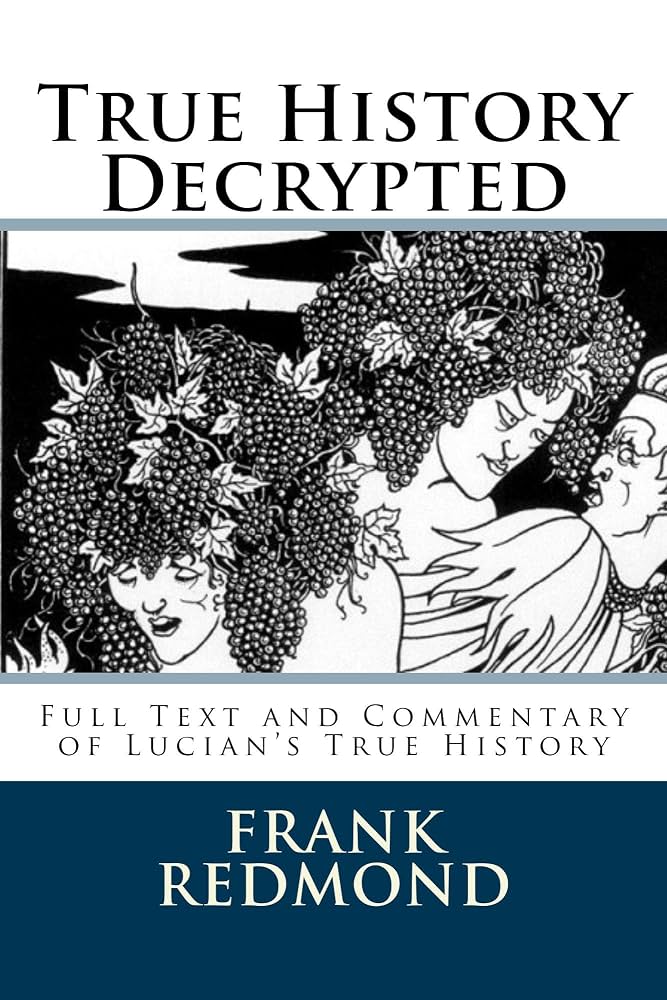
In A True History, Lucian satirizes the ridiculous aspects of travel writing and history. Here, Lucian and his crew get caught in a storm and are blown to the moon. Among a host of adventures is one in the belly of a whale. The thing is, what the true travel and historical accounts say is sometimes just as insane as his whole story. This edition highlights the passages from Herodotus, Homer, and others that he cites. It’s very silly and, obviously, a precursor to works like Gulliver’s Travels, which I believe was itself a satire of the travel writing of Swift’s day, along with a send-up of many political, social, and religious issues.
One thing I came away from it with is that Lucian was doing surrealism, absurdism, postmodernism, and bizarro fiction before we had names for them. I suppose several of the people he was satirizing were, too. (So was Rabelais!) In some manner, traveling to the moon, etc., I guess he’s also writing science fiction.
Matthew Gregory Lewis: The Monk: A Romance (1796)
By the end, it was a lot of fun, but it definitely took time to get used to the writing. Partly because Lewis was 19 when he wrote it, and even though it was praised for its style and not much else when it was published, it felt overwritten and all over the place stylistically to me. Even halfway through, I wasn’t sure if I liked it, but I would reread it. It ended up being a lot of fun.
It has a lot of early Gothic elements — castles, monasteries, statues, a love story, catacombs, etc. It is often told episodically, and at first the reader isn’t sure how things tie together—oh, yeah—messy families, hidden identities, etc. What really sets it apart, though, is its willingness to dive into the horrorific aspects beyond the gloomy atmosphere. Though I remember Poe referencing the Romantics, particularly Byron and Shelley, Lewis must have been some influence. Turns out Lewis, a member of Parliament, was also friends with Goethe, Byron, and both Shelleys. Wild!
George Eliot: Middlemarch (1872)
I have read writers talking about Middlemarch for decades, and I actually read some George Eliot in high school and always liked her books, though I wouldn’t admit to it then. My peers were outrightly disgusted by her work, a disgust usually reserved for poetry or anything Shakespeare. Along with rereading her work, I want to get a copy of her translation of Spinoza’s Ethics. It likely influenced some of the ideas here, but I sensed some of Hegel, and it turns out her partner translated and worked with Hegel’s texts (they couldn’t be married because his wife wouldn’t grant a divorce — I want to check out a bio now too!).
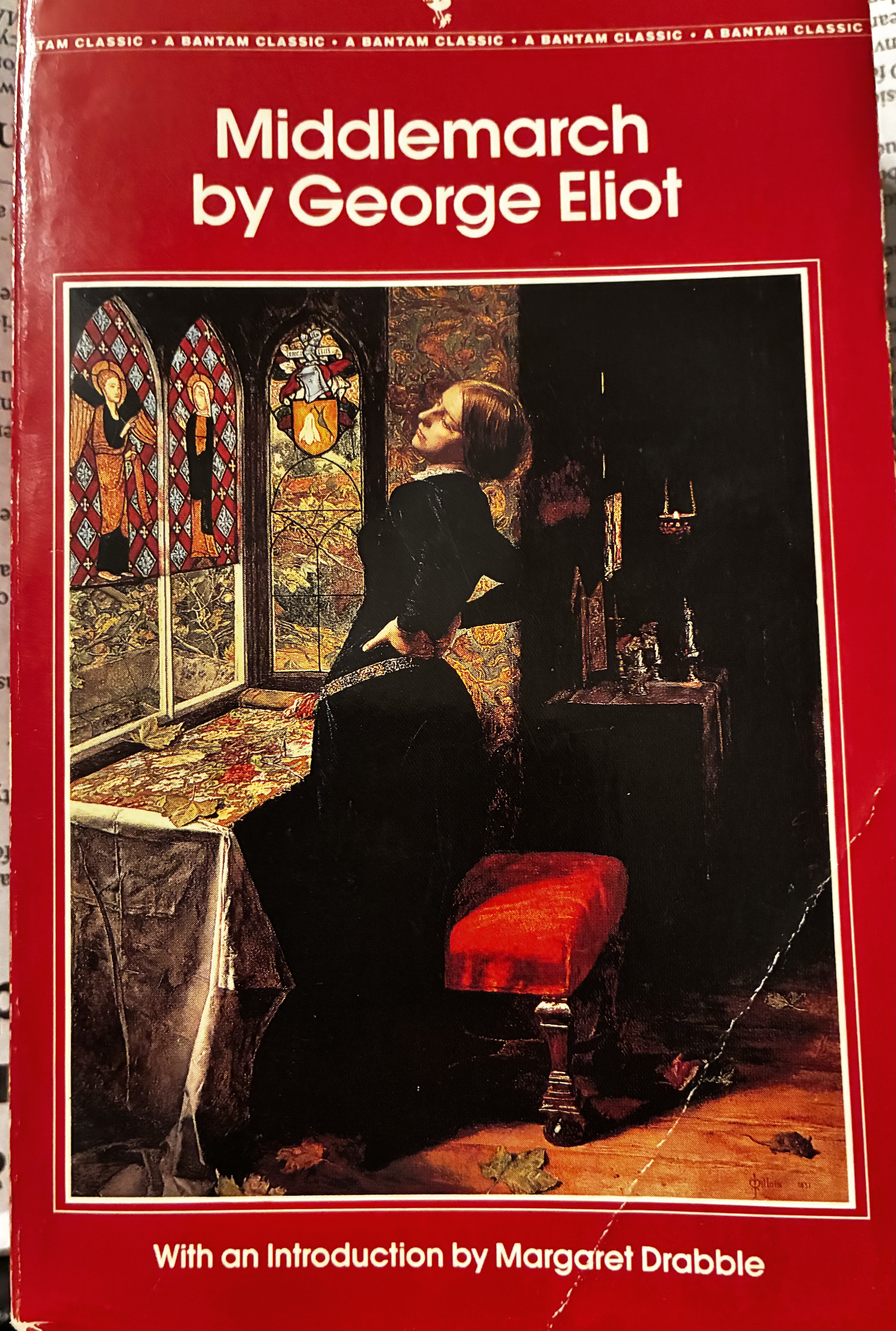
Middlemarch is a provincial town in the middle of England, but close enough to London that characters talk about traveling there. Couples fall in love, but the novel also explores the social, political, and economic forces that shape their lives and interfere with them. Throughout the book, there were only two brief spots where I felt it slowed down, and part of that was because a group of new council fuddy-duddies was introduced. On a second read, I don’t think I’d feel that at all. The last 300 pages felt propulsive to me, even with little of what most readers would call action.
Samuel Butler: Erewhon (1872)
I guess I can’t escape my interest in utopian/dystopian fiction. This was fun, a kind of Jonathan Swift meets H. G. Wells tale that prefigures aspects of sci-fi and fantasy dystopias down the line, including “Harrison Bergeron” by Vonnegut. At some point, I want to get a scholarly annotated version. I don’t know much about Butler.
It’s the stranger-in-a-strange-land thing, mixed with British travel writing. I’m curious to know how much of the colonialism is satire. Like many of these, it has some fantastic images scattered throughout. Oh, and in Dune, there’s a reference to the Butlerian Jihad, which is this. It’s about getting rid of thinking machines (if I remember correctly).
My favorite image from the book is a Stonehenge-like stone circle made of statues that are also a giant pipe organ powered by wind. I didn’t notice that Erewhon and Middlemarch were published in the same year until organizing this. Based on reading them, I would have guessed that Butler was writing in a much earlier period.
E.M. Forster: “The Machine Stops” (1909)
I kept hearing about this early sci-fi novel and how good it was, but when I found it online, it was only about 30 pages long. It’s great. Some of Forster’s story collections are titled The Machine Stops, which may be confusing. While not perfect and maybe too generous towards humanity, it’s a fascinating read given our current time. Humans live underground in small rooms and communicate electronically for everything. There seems to be an eco-collapse, and travel has become rare. Most people fear it and prefer to be in their rooms, where they feel they can get everything they need. Reading this in the context of the Internet, apps like Zoom, and AI feels like we’re almost there.

